What Is Sewer Flow Monitoring?
Engineering Guide
Flow monitoring measures more than depth
True sewer flow monitoring uses field data to measure velocity, depth, and calculated flow so agencies can understand actual system behavior.
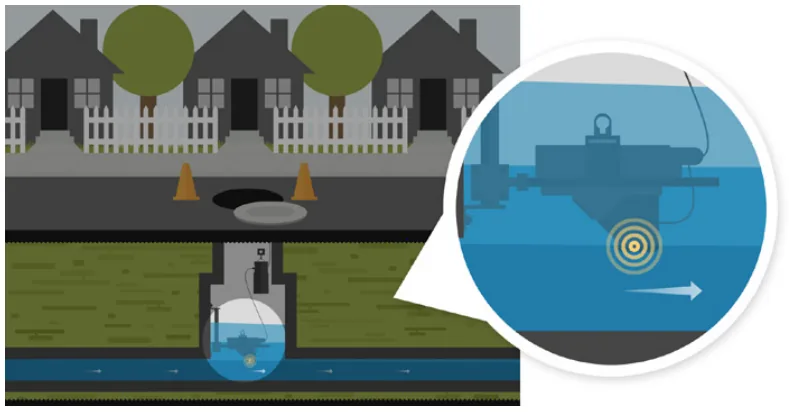
Sewer flow monitoring is the process of continuously measuring wastewater velocity, depth, and flow rate inside active sanitary sewer manholes. Engineers use this data to understand how a collection system behaves under both dry weather and wet weather conditions — replacing assumptions with measured evidence.
How Area-Velocity Sensors Work
The standard instrument for sewer flow monitoring is an area-velocity sensor installed on the pipe invert inside a manhole. These sensors measure two parameters simultaneously: the velocity of the wastewater stream and the depth of flow above the sensor.
Velocity is measured using either Doppler ultrasonic technology (which bounces sound waves off particles suspended in the wastewater) or electromagnetic induction (which measures the speed of conductive fluid passing through a magnetic field). Depth is measured using an ultrasonic transducer aimed upward from the sensor to the water surface.
Flow rate is then calculated using the continuity equation: Q = A × V, where Q is flow rate, A is the cross-sectional area of flow (derived from depth measurement and known pipe geometry), and V is the measured average velocity. At a typical 15-minute recording interval, this produces 96 flow measurements per day per monitoring location.
Why Municipalities Require Flow Monitoring
Municipalities and utilities require measured sewer flow data for several critical engineering and regulatory purposes:
Capacity certification for new development depends on measured peak flows, not estimates. Without a PE-stamped capacity study, municipalities cannot issue building permits or sewer connection agreements.
EPA consent decree compliance requires documented flow conditions. Federal consent decrees mandate that municipalities demonstrate understanding of their system's actual capacity and wet weather response using measured data.
Hydraulic model calibration needs measured diurnal patterns and wet weather response data. Models built on assumed flows routinely overestimate or underestimate actual conditions by 30–65%, leading to misallocated infrastructure spending that can reach tens of millions of dollars.
Capital improvement programs must be justified with field-measured evidence of capacity deficiencies. Regulatory agencies and municipal bond underwriters require measured data to support infrastructure investment decisions.
Types of Sewer Flow Monitoring Programs
Capacity studies typically require 7–14 days of dry weather monitoring to establish baseline flow conditions. These short-term programs produce the average daily flow, peak hour flow, peak-to-average ratio, and minimum night flow parameters needed for capacity certification.
RDII studies require 30–56 days to capture multiple storm events for wet weather analysis. Rain gauges are co-located to record precipitation at 1-minute intervals, allowing engineers to correlate rainfall with sewer flow response and quantify the volume of stormwater entering the sanitary system.
Model calibration programs run 3–6 months to capture seasonal variation in flow patterns, including summer vs. winter diurnal curves and response to storms of varying intensity and duration.
Consent decree programs run 12–18 months for comprehensive system characterization. These long-term programs capture the full range of seasonal conditions and provide the sustained monitoring record required by EPA enforcement actions.
Data Quality and Telemetry
Modern sewer flow monitoring uses cellular telemetry to transmit data from field sensors to engineering staff in near real time. This allows daily quality assurance review, immediate detection of sensor issues or anomalous flow events, and remote access to monitoring data without field visits. Professional monitoring programs target 95%+ data uptime — meaning usable, quality-verified data for at least 95% of the monitoring period.
Industry Standards and Safety
All sewer flow monitoring installations require confined space entry under OSHA 29 CFR 1910.146, including atmospheric testing, assigned entry roles, and continuous monitoring during manhole entry. The flow meter installation process follows established industry practices recognized by EPA SWMM, InfoWorks ICM, SewerGEMS, XPSWMM, and ESRI modeling platforms.
Need this service? Learn about our sewer flow monitoring services or request a quote.
Request a Quote
Fixed-scope proposals within approximately 24 hours. No open-ended billing.